Alaska’s clean energy industry faces significant workforce challenges, influenced by statewide difficulties as well as industry-specific issues. And an insufficient local energy workforce severely impacts economic development across the state. High energy costs, environmental degradation, unreliable service, and long-duration power outages have cascading negative effects on vital dual-use infrastructure, community services, economic opportunities, and individual livelihoods. As interest and urgency in clean energy workforce development grows, REAP’s recent workforce analysis, Powering Alaska’s Future: Opportunity Analysis of Clean Energy Workforce Challenges and Potential Solutions, examines the most impactful and effective pathways to developing and supporting more homegrown energy workers.
For this third edition in our four-part series expanding on findings from the Opportunity Analysis, we turn to the leading strategies for accelerating clean energy workforce growth, and some of the efforts already making headway throughout the state (Chapter 3, p. 30). Our last blog post in this series discussed five overarching challenges slowing down workforce recruitment, retention, and training across the state, and our first installment shared the current state of Alaska’s clean energy workforce and the highest-need clean energy occupations. Our fourth and final blog post in this series will share future research possibilities and REAP’s workforce development priorities moving forward.
Five Promising Pathways
Interviewees and Alaska Energy Training Group participants described a range of strategies to overcome these challenges, with varying timelines, impacts, and partners. The following recommendations emerged as five approaches that could have the greatest impact on accelerating clean energy workforce development across the state. Many of these strategies address multiple challenges and can be used together for maximum impact.
1. Pursue regional shared services for rural clean energy infrastructure and workers.
Sources shared ideas for various regional actions to overcome high infrastructure costs, limited training access, and rural recruitment and retention difficulties (p. 30), including:
- Regional utility collaboratives that pool funds, plan projects, and share dedicated staff
- Independent power producers that operate under a regional umbrella with shared supportive staff
- Centralized administrative and bookkeeping services within a region
- Shared service contracts with in-region businesses
- Coordinating preventative maintenance and training with traveling technicians and mechanics among nearby communities
Regional electrical services in Unalaska
In Unalaska, electrical and telecommunications service provider OptimERA has a long-term contract with the city-run local electric utility to provide linemen. The arrangement, which grew out of the city’s persistent challenges recruiting and retaining linemen, allowed OptimERA to offer more attractive rotational schedules and to staff a growing apprenticeship program. “If you want really seasoned, educated people, you have to start somewhere,” said OptimERA Chief Operating Officer Matthew Scott.
If each community works as an island, costs pile up. If you don’t build capacity locally and you can’t take care of your own problems, you’re going to get left behind.
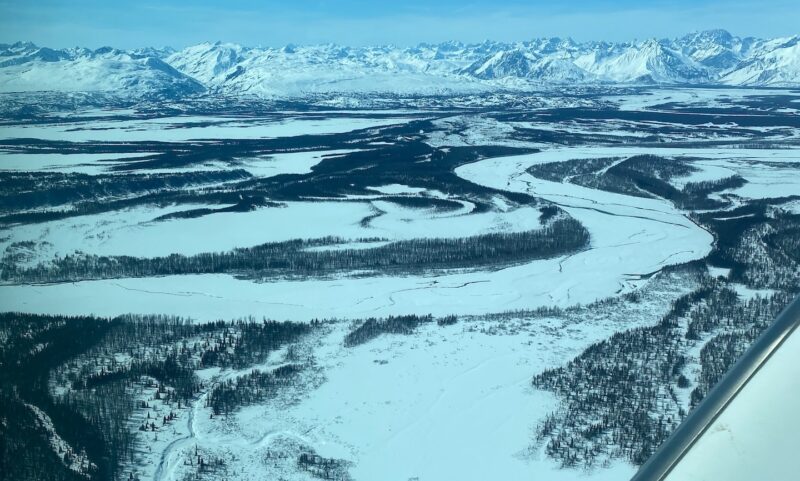
Wintertime in Southwestern Alaska’s Lake and Peninsula Borough. Photo: Jenny Starrs/REAP
2. Increase opportunities for local employment and work-based learning in energy projects.
Generic classes don’t always go well. The most effective thing is to sit next to a utility clerk and go through their file cabinets with them, teach them how to do annual reports, including backup, how to set customer rates based on expenses, and create a list of what and when to submit all required paperwork.
Multiple interviewees suggested that adding a range of work-based training methods could increase access to training and overcome instructor shortages and geographic limitations better than short-term group training programs and intensives (p. 32). Their ideas and initiatives included:
- More paid on-the-job learning opportunities, like apprenticeships and internships
- Skills banks to connect local workers to local training and infrastructure projects
- Individualized in-community assistance from local experts
- Hybrid professional development cohorts
- Local mentorship connections
Connecting remote work with local talent
Remote Hands launched in the spring of 2025 to provide a platform for connecting technicians in rural areas of Alaska with contracted work opportunities. The platform marries local training opportunities and credentials with local employment opportunities that range from paperwork assistance to installing Starlink terminals. “It helps keep talent in communities and saves outside entities money,” said Gabe Low, Remote Hands Founder. There are plenty of potential challenges and pitfalls for the new endeavor, including local employee retention, work verification, and compensation structures, but the company is moving quickly to cement partnerships with big infrastructure projects and funders and recruit local talent to test out their model.
3. Advance creative partnerships between and among training providers and the energy industry.
Encouraging closer communication and collaboration between regional training centers, school districts, unions, trade associations, state agencies, individual instructors, and employers was put forth as the central path to combatting instructor shortages and increasing training access around the state (p. 34). The avenues suggested for fostering these working relationships included:
- Accessible industry advisory groups for input on curriculum and credentials
- Community of practice for educators and industry to share pain points, scope opportunities, and forge connections
- Train-the-trainer industry partnerships to cultivate new part-time instructors
- Industry-sponsored instructor shadows, swaps, or sabbaticals
- Industry instructor directory for short-duration itinerant positions
Train-the-trainer momentum for solar installers
The University of Alaska Fairbanks’ Bristol Bay Campus (UAF BBC) launched a “train-the-trainer” initiative to boost the number of solar installation training professionals in Alaska in the spring of 2023. By casting a wide net, covering tuition and attendance costs, and offering industry-friendly teaching schedules, the campus regularly offers a 2-credit Solar Electric Design and Installation class taught by its former trainees. “We invested a lot in getting people set up as instructors,” said Chandler Kemp, Assistant Professor of Sustainable Energy at UAF BBC and an energy efficiency consultant.
It takes a special skillset to become an educator. They have to want to give back a little bit.
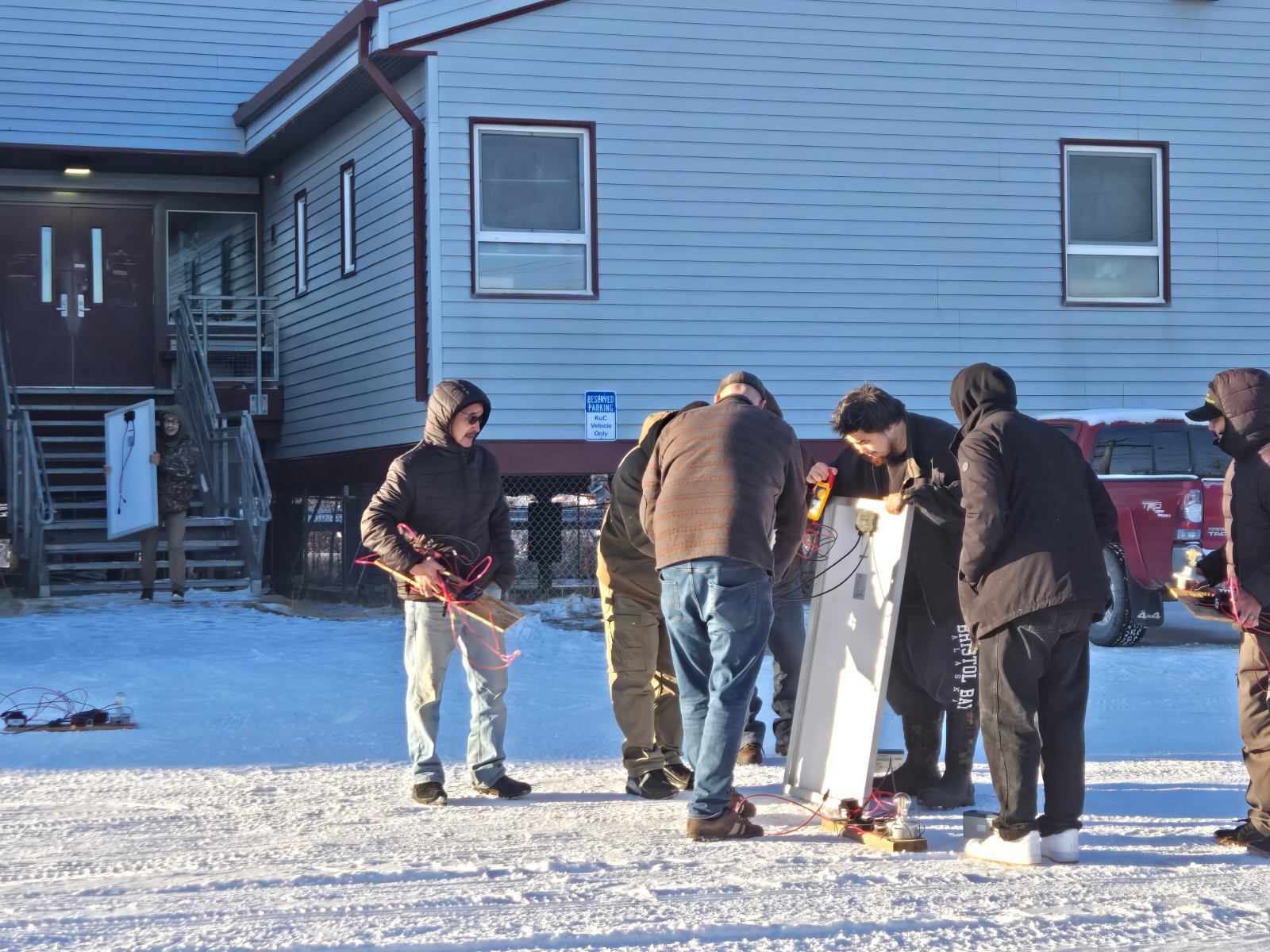
Instructors and students practice wiring a solar panel during a weeklong solar training in Bethel. Photo: Jacob Ivanoff
4. Expand local opportunities for energy education and career awareness.
You have to build the understanding of what energy means for businesses and homes to build demand.
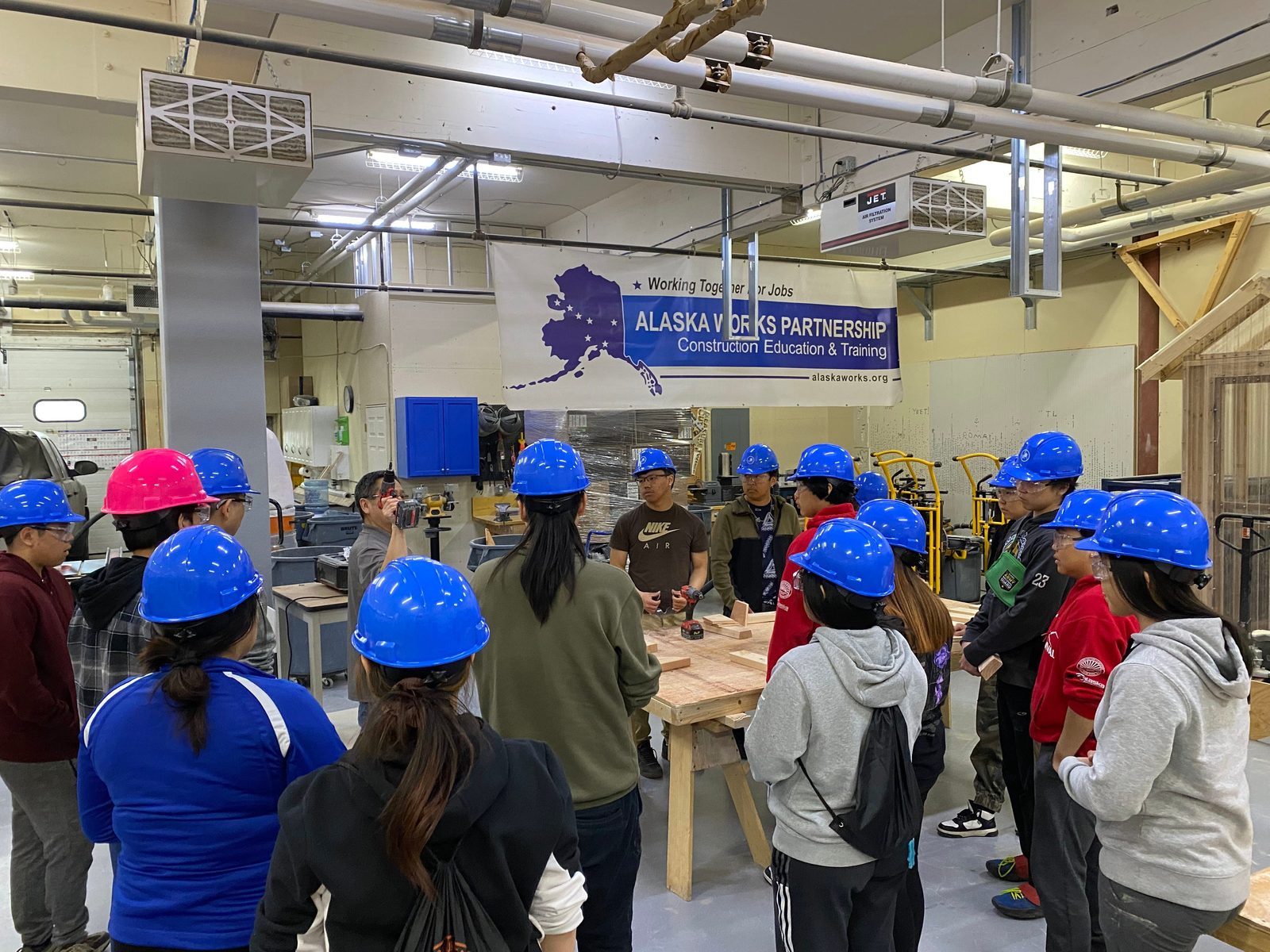
An Alaska Works Partnership carpentry instructor demonstrates how to safely use power tools to a group of high school students from the Lower Yukon School District’s Kusilvak Career Academy. Photo: Jenny Starrs/REAP
Education was mentioned as a pathway to grow the future clean energy workforce, raise awareness and respect for essential energy workers, and build demand and buy-in for clean energy infrastructure (p. 36). Twelve interviewees and multiple Alaska Energy Training Group meetings raised this strategy, with their specific ideas including:
- K-12 energy lessons and courses
- Utility internships or job shadows
- Construction trades pre-apprenticeships
- Community energy or career fairs
- Community involvement in energy projects and planning
- Technical assistance and outreach to consumers and businesses about clean energy incentive and assistance programs
Introductory construction trades training
Alaska Works Partnership (AWP) has delivered introductory training and pre-apprenticeships to Alaskans across the state for the past 30 years. Their work is critical for energy efficiency careers like weatherization, building maintenance and management, and construction. They pair foundational building trades training with individualized career counseling and application assistance. “We want to help people find the right fit,” said Tiffany Caudle, AWP’s longtime training coordinator.
5. Research, implement, and bolster financing strategies for building and maintaining clean energy projects.
Interviewees from both energy businesses and nonprofits pointed to the persistent need to develop a sustainable market for statewide clean energy projects and new ways to finance their operations and maintenance in rural areas (p. 39). Insulating projects from the boom-and-bust cycle of federally available funding and programs, as well as finding new funding for long-term operations and maintenance, were described as key to growing Alaska’s clean energy workforce and infrastructure. Fifteen interviewees discussed this topic, with many focusing on the long-term need to broaden demand and increase market adoption to sustain in-state expertise. The financing ideas mentioned were:
- Rebate and on-bill financing programs
- Revolving loan funds
- Long-term grant programs
- Long-term tax incentives
- Green Bank capitalization
Beneficial electrification rebates in Southeast Alaska
Alaska Heat Smart maintains a list of qualified contractors that work in coastal Southcentral and Southeast Alaska communities as part of its work on Accelerating Clean Energy Savings (ACES), a five-year heat pump rebate program that started in 2024. With applications growing, they received inquiries from HVAC companies and contractors in Anchorage, the Matanuska-Susitna Borough, and even the Pacific Northwest. As of May 2026, their contractor list included more than 30 entities.
Build the demand, and the workforce will come. We’re seeing this work with the ACES program, with at least one shop in Juneau adding staff and a new HVAC business opening its doors.
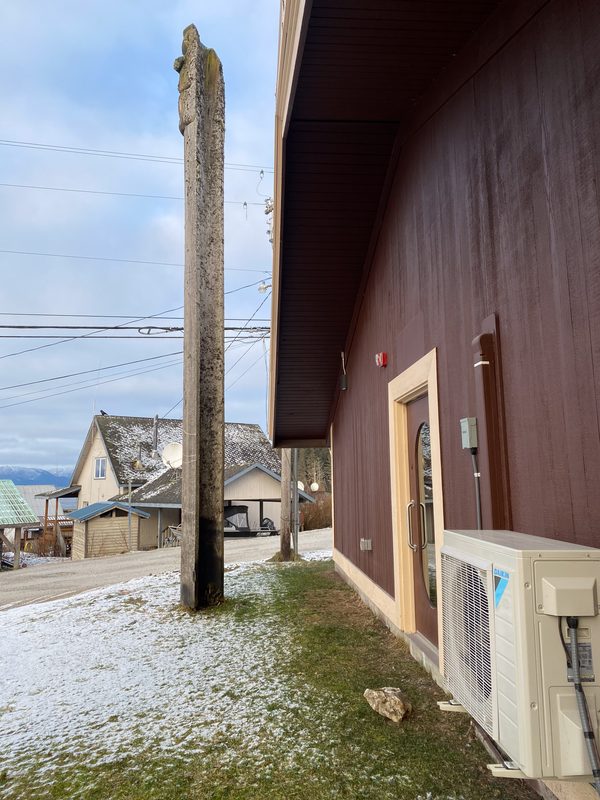
A heat pump installed in the Southeast Alaska community of Angoon. Photo: Jenny Starrs/REAP
What Lies Ahead
Implementing these strategies takes creativity, collaboration, and perseverance. And while that can add complexity to getting initiatives up and running, it also makes them more resilient. Many of the efforts highlighted in this blog post and in the full Opportunity Analysis have weathered funding fluctuations and changing political winds to build lasting progress. In the final installment of this series, we will share conclusions from the year-long research process, including future research opportunities for the industry and future workforce development priorities at REAP.